| Description | Zhuan Shu | Description | |
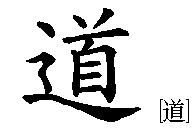 "Dao" - Way |
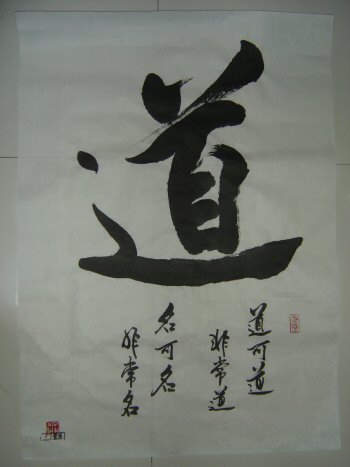 Tao and First Line of Tao Te Ching |
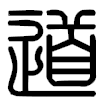 "Dao" - Way |
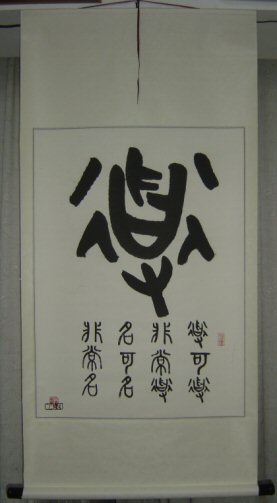 Tao and First Line of Tao Te Ching |
Daoist Chinese Characters |
|---|
|
|
The following are selected important Daoist Chinese characters and their definitions.In Chinese, there are different styles to write a character. This is because the characters developed from Pre-Qin dynasty to today, went though many stages of development.
The China government in the 1950's simplified the Chinese characters into a version called Simplified Chinese, and the original one then became know as Traditional Chinese (used in Taiwan, Hong Kong, and elsewhere). Note that the Chinese characters in brackets used on this site are the Simplified Chinese Kai Shu version. Since Lao Zi was in the Zhou dynasty (which is pre-Qin dynasty: See Chinese History), the Chinese style that the Dao De Jing was written in was a variant of the Zhuan Shu. |
| Description | Zhuan Shu | Description | |
"Dao" - Way |
Tao and First Line of Tao Te Ching |
"Dao" - Way |
Tao and First Line of Tao Te Ching |
| Kai Shu | Description | Zhuan Shu | Description |
"Dao" - Way |
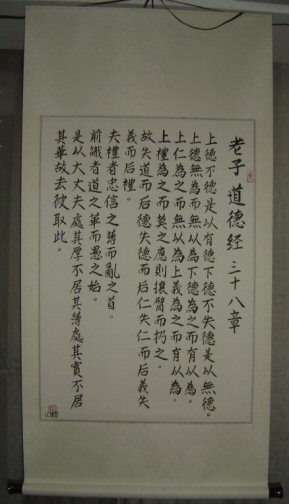 Chapter 38 of Tao Te Ching in Kai Shu style |
"Dao" - Way |
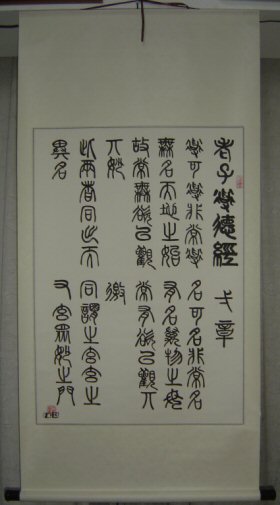 Chapter 1 of Tao Te Ching in Zhuan Shu style |
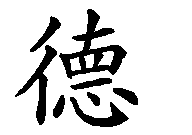
"De" - Virtue |
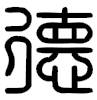 "De" - Virtue |
||
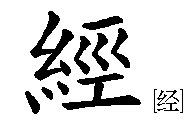
"Jing" - Scripture |
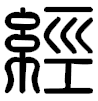 "Jing" - Scripture |
| Zhuan Shu | Description | |
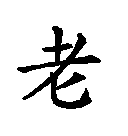
"Lao" - Old |
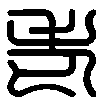 "Lao" - Old |
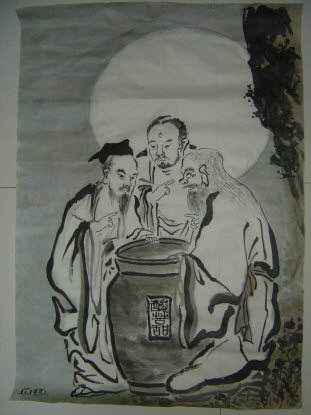 Three Vinegar Tasters Painting |
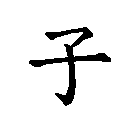
"Zi" - Child |
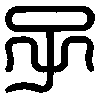 "Zi" - Child |
| Zhuan Shu | Description | Description | |
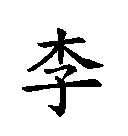
"Li" - Plum tree |
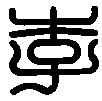 "Li" - Plum tree |
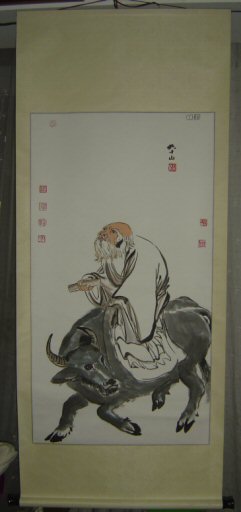 Lao Zi Riding Ox |
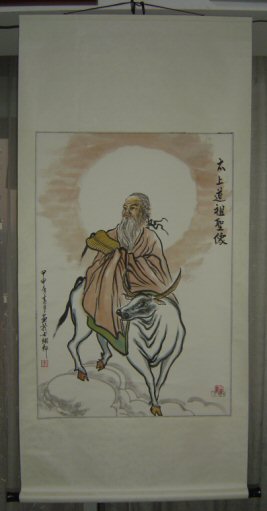 Lao Zi Riding Yak |
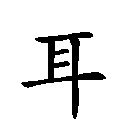
"Er" - Ear |
 "Er" - Ear |
| Zhuan Shu | Description | |
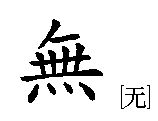
"Wu" - Without (Effortless) |
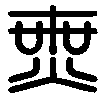 "Wu" - Without (Effortless) |
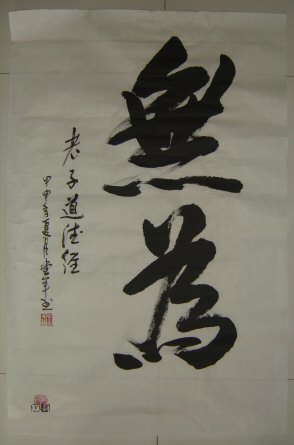 Wu-Wei Calligraphy |
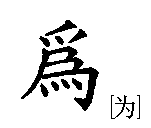
"Wei" - Action |
 "Wei" - Action |
| Zhuan Shu | Description | |
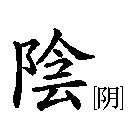
"Yin" - Feminine or negative principle |
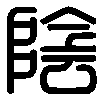 "Yin" - Feminine |
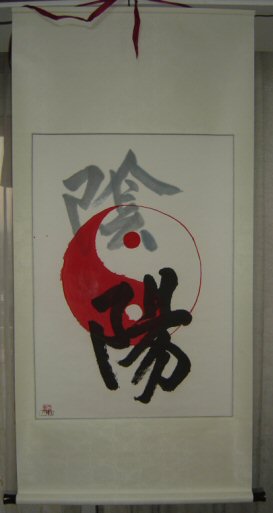 Yin Yang Calligraphy |
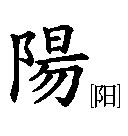
"Yang" - Masculine or positive principle |
 "Yang" - Masculine |
| PinYin | Strokes | Definition | Character | PinYin | Strokes | Definition | |
| beng | 52 | roar of thunders | ? | 31 | ? | ||
| da | 48 | the appearance of a dragon walking | ? | 31 | ? | ||
| ye | 44 | lots of fish | ? | 31 | ? | ||
| bing | 39 | thunder voice | bao | 31 | a bird resembling the wild goose | ||
| dui | 36 | cloudy | ling | 31 | mountain deity; with human face and animal body | ||
| nang | 36 | having one's nose stuffed up, or having unclear pronunciation due to a stuffy nose | ling | 31 | frames on the sides and front of a carriage, wheels of a carriage | ||
| ya | 35 | dented; chipped; gap-toothed; toothless | nang | 31 | bread | ||
| ling | 35 | wagtail | yan | 31 | overflowing, billowing; wavy | ||
| ? | 35 | ? | yan | 31 | goat | ||
| yan | 35 | fine teeth, irregular teeth | ? | 30 | ? | ||
| shen | 34 | numerous; very many, large group of horses traveling in a line | ? | 30 | ? | ||
| ling | 34 | name of a god; a legendary spirits having the face of a man and the body of a beast | ti | 30 | to sneeze; a running at the nose | ||
| ? | 33 | ? | zhuo | 30 | fishing bamboo cages | ||
| xian | 33 | fresh, new, delicious; rare, few | li | 30 | eel | ||
| cu | 33 | rough, coarse, big, rough | yuan | 30 | a spring; source | ||
| ling | 33 | dragon; work properly, spirit | luan | 30 | poor health, restrained, crooked | ||
| yu | 33 | to smoke, fumigate; to bleach with burning sulfur | luan | 30 | fabulous bird | ||
| ? | 33 | ? | biao | 30 | horses | ||
| yu | 32 | rich, great wave | guo | 30 | a country; a nation; a kingdom; a state | ||
| yuan | 32 | a flock of birds | xian | 30 | to have insight or vision of a simple and honest person, silly | ||
| ? | 32 | ? | ? | 30 | ? | ||
| da | 32 | flight of a dragon | ? | 30 | ? | ||
| bao? | 32 | ? | ? | 30 | ? | ||
| yu | 32 | appeal; request; implore | ? | 30 | ? | ||
| yu | 32 | fragrant herb; fragrant plant; tulip | ? | 30 | ? | ||
| ? | 32 | ? | ? | 30 | ? | ||
| ? | 32 | ? | ? | 30 | ? | ||
| ? | 31 | ? | ? | 30 | ? | ||
| ? | 31 | ? | ? | 30 | ? |
| PinYin | Strokes | Definition | Character | PinYin | Strokes | Definition | |
| beng | 52 | roar of thunders | zhan | 12 | to open, to stretch; to extend, to unfold; to dilate; to prolong | ||
| ye | 44 | lots of fish | mang | 12 | crowded multitude of grass | ||
| bao? | 32 | ? | lei | 12 | public opinion; clamour; noise; thunder | ||
| ? | 16 | ? | zhuo | 8 | to connect | ||
| lang | 16 | bright | li | 8 | scattered or dispersed and clear, to stop, to detain, a connection, lineage | ||
| man | 16 | great currents | yu? | 8 | ? | ||
| yi | 16 | appearance of fire | |||||
| PinYin | Strokes | Definition | Character | PinYin | Strokes | Definition | |
| ? | 20 | ? | biao | 4 | fire | ||
| ? | 16 | ? | si | 4 | four | ||
| kui | 12 | earth; land; soil; ground; territory, opium |
| PinYin | Strokes | Definition | Character | PinYin | Strokes | Definition | |
| da | 48 | the appearance of a dragon walking | ? | 15 | ? | ||
| bing | 39 | thunder voice | sen | 12 | forest | ||
| dui | 36 | cloudy | bi | 12 | able to support great weight | ||
| xian | 33 | fresh, new, delicious; rare, few | biao | 12 | running dog | ||
| cu | 33 | rough, coarse, big, rough | cui | 12 | fine hair or fur on animals | ||
| yuan | 30 | a spring; source | ben | 12 | run fast, flee; rush about; run | ||
| biao | 30 | running; herd of horses | suo | 12 | worried | ||
| guo | 30 | a country; a nation; a kingdom; a state | yan | 12 | spark | ||
| xiu | 27 | resembling a stampede | jing | 12 | crystal; clear, bright; radiant | ||
| xun | 27 | group of springs | pa | 12 | pickpocket | ||
| xin | 27 | fragrant, aromatic; distant fragrance | miao | 12 | expanse of water | ||
| fei | 27 | ? | se | 12 | ? | ||
| chu | 24 | straight, upright, erect, lofty | pin | 9 | article | ||
| xin | 24 | used in names | hui | 9 | a general term for plants | ||
| za | 24 | complicated | mo | 9 | |||
| yue | 24 | the water is waving in the breeze, old and desolate; rags and rubbish | yao | 9 | mound, roundish mass | ||
| ? | 24 | ? | zhuan | 9 | cautious; weak; orphans | ||
| bi | 21 | able to support great weight | biao | 9 | running; herd of horses | ||
| hong | 21 | rumble, explosion, blast | jian | 9 | wicked, evil | ||
| ta | 21 | to talk quickly | zhuang | 9 | big, large; robust; name of tribe | ||
| chong | 18 | worms; insects | ? | 9 | ? | ||
| hua | 18 | to stir up trouble | li | 6 | last name | ||
| nie | 18 | whisper | zhong | 6 | crowd | ||
| ? | 18 | ? | lei | 6 | fortress | ||
| shan | 18 | flock of sheep | xie | 6 | cooperate; combined labor | ||
| lei | 15 | field divided by dykes | ruo | 6 | obedient; united | ||
| jing | 15 | beautiful eyes | san | 6 | to like, love, enjoy; a joyful thing | ||
| xiao | 15 | bright | hui | 5 | general term for plants; myriads | ||
| lei | 15 | pile of rocks or stones | |||||
| PinYin | Strokes | Definition | Character | PinYin | Strokes | Definition | |
| ? | 24 | ? | zhong | 6 | all; the whole of; a multitude, a crowd (three or more) | ||
| she | 12 | to wade, to experience, to involve; to implicate | chuan | 3 | river | ||
| cheng | 12 | ? | chuan | 3 | stream, river; flow; boil | ||
| tan | 12 | embers | xian | 3 | hair | ||
| zhou | 6 | prefecture | san | 3 | three |