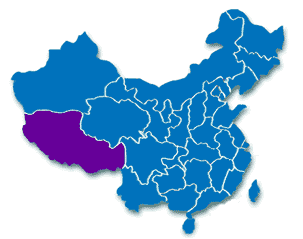
Provinces
Anhui
Fujian
Gansu
Guangdong
Guizhou
Hainan
Hebei
Heilongjiang
Henan
Hubei
Hunan
Jiangsu
Jiangxi
Jilin
Liaoning
Qinghai
Shaanxi
Shandong
Shanxi
Sichuan
Yunnan
Zhejiang
Autonomous
Regions
Guangxi
Neimenggu
(Inner Mongolia)
Ningxia
Xinjiang
Xizang
(Tibet)
Municipalities
Beijing
Chongqing
Shanghai
Tianjin
Special
Administrative
Regions
Aomen
(Macau)
Xianggang
(Hong Kong)

Tibet Autonomous Region of the P.R.C.

Xizang Discussion Forum

Abbreviation
XZ
Population
2.62 million
Area
1201000 sq Km
Location
Western China
GDP
RMB 10.56 billion
Provincial Capital
Lhasa
Per Capita GDP
RMB 4262
Separate Planning City


Climate:

Tibetan winters, as might be supposed, are fiercely cold. But for half the year, strong sunlight warms the thin air, making most days in Lhasa comfortably mild and, owing to protective mountains, relatively windless. Summer temperatures hover above 30'C (high-80s F) and only to drop to a searing -23'C (-10'F) in midwinter. The best time to visit is from late spring to early fall

.

Ethnic Groups:

Tibetan,Han


Agriculture:

The development of agriculture and animal husbandry has been given top priority in the Tibetan economy. Tibet's production levels of agriculture and animal husbandry rose greatly. Since 1980, the government has imposed no levies on farmers and herdsmen, with both agricultural and livestock taxes exempted. Introduction of modern tools for production and the application of science and technology have boosted overall production.


Industry: Modern industry started after the democratic reform. In 1965, 80 industrial enterprises were established in Tibet. Employing some 10,000 people, they covered the building, power, motor vehicle repair, lumber, tanning, borax and coal industries. The total industrial output value reached 28.83 million yuan that year. The government has paid close attention to the development of local handicrafts.
Return to China Depot