Provinces
Anhui
Fujian
Gansu
Guangdong
Guizhou
Hainan
Hebei
Heilongjiang
Henan
Hubei
Hunan
Jiangsu
Jiangxi
Jilin
Liaoning
Qinghai
Shaanxi
Shandong
Shanxi
Sichuan
Yunnan
Zhejiang
Autonomous
Regions
Guangxi
Neimenggu
(Inner Mongolia)
Ningxia
Xinjiang
Xizang
(Tibet)
Municipalities
Beijing
Chongqing
Shanghai
Tianjin
Special
Administrative
Regions
Aomen
(Macau)
Xianggang
(Hong Kong)

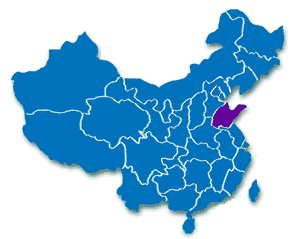
Shandong Province of the P.R.C.

Shandong Discussion Forum

Abbreviation
SD
Population
90.79 million
Area
153800 sq Km
Location
Eastern China
GDP
RMB 766.21 billion
Provincial Capital
Jinan
Per Capita GDP
RMB 8673
Separate Planning City
Qingdao


Climate:

Shandong has a warm-temperate monsoonal climate, with hot, rainy summers and dry, sunny winters. In winter, it is more humid and warm in Shandong than in north China. Its coastal and inland regions experience a sharp difference in climate. Shandong has a mean annual temperature of 12бугн14буC, increasing from the northeastern seaboard to the west and the south, and a mean annual precipitation of 500-900 mm or more, increasing from northwest to southeast.

.

Ethnic Groups:

Han, Hui, and Man.


Agriculture:

Shandong has a long history of tobacco and tussah growth. It is also a famous temperate fruit grower. The apples of Yantai, the pears of Laiyang, the small dates of Leling and the watermelons of Dezhou are particularly well known. The offshore waters are rich in fish, prawns and kelp. It is also a major producer of wheat, corn, cotton and other corps. Its peanut production accounts for a quarter of the nation's total.


Industry: The province has large deposits of petroleum, natural gas, coal, iron, diamonds and bauxite. Its gold output ranks first in China. The Shengli Oilfield, the country's second biggest crude-oil producer, is located in northwestern Shandong near where the Yellow River discharges into the Bohai Gulf. Xindian in Zibo is an rising chemical industrial center.
Return to China Depot