Provinces
Anhui
Fujian
Gansu
Guangdong
Guizhou
Hainan
Hebei
Heilongjiang
Henan
Hubei
Hunan
Jiangsu
Jiangxi
Jilin
Liaoning
Qinghai
Shaanxi
Shandong
Shanxi
Sichuan
Yunnan
Zhejiang
Autonomous
Regions
Guangxi
Neimenggu
(Inner Mongolia)
Ningxia
Xinjiang
Xizang
(Tibet)
Municipalities
Beijing
Chongqing
Shanghai
Tianjin
Special
Administrative
Regions
Aomen
(Macau)
Xianggang
(Hong Kong)

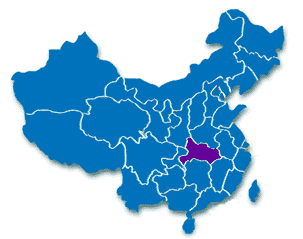
Hubei Province of the P.R.C.

Hubei Discussion Forum

Abbreviation
HB
Population
60.28 million
Area
187400 sq Km
Location
Central China
GDP
RMB 385.80 billion
Provincial Capital
Wuhan
Per Capita GDP
RMB 6514
Separate Planning City
None


Climate:

Hubei has a sub-tropical monsoonal climate, with distinct contrast between the eastern plain and the western mountainous area. It has a mean annual temperature of 15¡ã£­17¡ãC. and sticky weather in the height of summer. With its absolute maximum temperature exceeding 40¡ãC, Wuhan is one of the hottest places in China. The mean annual precipitation increases from 800 mm in the northwest to 1,500 mm or more in the southeast.

.

Ethnic Groups:

Han, Tujia, Hui, Miao, and Mongol.


Agriculture:

As far as crop planting is concerned, Hubei ranks among the best in China. The outputs of grain production, cash and other crops occupy very important positions nationwide, abounding in producing rice, cotton, wheat, maize, and edible oil. Hubei also teems with cash crops as tea, natural silk, tobacco and fruit.


Industry: Hubei is rich in mineral resources. Out of the over 110 kinds of minerals found in Hubei, iron, copper, phosphorus, gypsum and rock salt occupy an important position nationwide, and the reserves of several minerals rank the first place in China such as phosphate rock, rutile, garnet, lime sulphur rock, idobromine and borax . The white fibre gypsum is of high grade. Enshi Tujia and Miao Autonomous Prefecture is rich in selenium resources rarely seen all over the world, with broad prospect for exploitation.
Return to China Depot